

In this article about what your optimal energy intake is: When you want to be conscious about your nutrition or have a specific health goal in mind, your energy intake, or the amount of calories you consume in a day, is of great importance. If your energy intake equals your energy expenditure (energy balance), your weight remains stable. If it is greater than your energy expenditure, your weight will increase, and if your intake is less than your expenditure, you will lose weight. This principle is fundamentally quite simple, but not very concrete yet. Therefore, it is interesting to ask yourself what determines your desired energy intake and even more interesting, how you can optimize it. We explain it.
Your optimal energy intake explained
Total daily energy expenditure
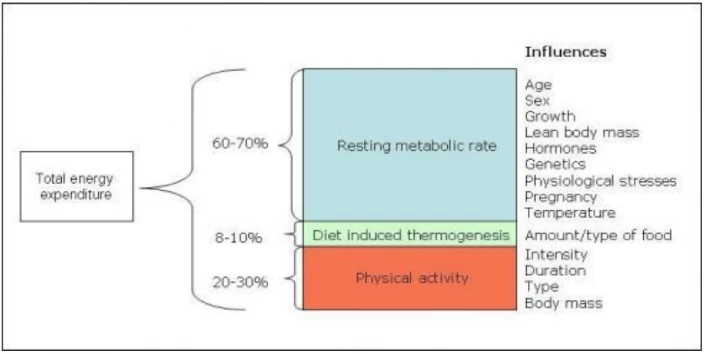
To determine what your desired energy intake is, we look at your energy expenditure, which is also referred to as your metabolism and is the sum of three components: your basal metabolic rate, which is the energy your body uses while you sleep, the thermic effect of your food, the percentage of energy intake needed to digest and absorb your energy, and your activity level, the amount of physical effort you exert in a day. These three components can each also be influenced by several factors such as age, sex, body temperature, type of food, or exercise intensity. The image below clearly shows your metabolism.
Basal metabolic rate
To determine your energy intake, it is therefore first important to be aware of your energy expenditure. Ask yourself about each component how the situation is for you. How is your sleep quality? Do you sleep long enough, do you suffer from stress, or are you pregnant? These are all elements that affect your rest and thus your basal metabolic rate.
Thermic effect
The type of product, your body fat percentage, and your carbohydrate tolerance all influence the thermic effect. If we assume mixed meals (proteins, fats, and carbohydrates), this percentage varies between 10 and 25%, with the lower limit for overweight individuals on an average diet and the upper limit for strength athletes with a high-protein diet and sufficient unsaturated fats. The higher the thermic effect, the higher your energy expenditure and the higher your energy intake can be. This must also be taken into account when determining your optimal energy intake.
Daily activity level
What is your daily activity level? If you have an office job, you burn significantly fewer calories daily than if you are on your feet all day. This also means that your energy intake should be lower if you have a sedentary job when you want to keep your energy levels balanced.
Total daily energy intake
What ultimately your optimal daily energy intake is, depends on your goal. Do you want to lose weight, gain weight, or do you want to maintain your current weight? Here’s an example.
Suppose two men both have the goal of losing weight. Man 1 works five days a week behind a computer, does not exercise, and maintains an average calorie intake. Man 2 works in construction, exercises twice a week at the gym, and also maintains an average calorie intake. Looking at the total energy expenditure of the men, Man 1's will be lower than that of Man 2. This means that Man 1's total energy intake should be lower than that of Man 2.
Interesting! And now?
To determine your energy intake, it is important to map out your energy expenditure and establish your personal goal. Based on that, we can calculate your optimal calorie needs. There are various formulas for this. Do you want to know what your optimal energy intake should be? Come by for a conversation and a measurement, and we will calculate this for you and provide tailored advice!
Also read: 5 breakfasts with more than 25 grams of protein · more articles on our blog · personal training at Daadkracht.