

In this article about heart rate variability, what is it: Heart rate variability (HRV) is receiving increasing attention, and not without reason! When you monitor HRV, you gain insight into the level of recovery and stress your body is experiencing. You might not expect it, but the higher the heart rate variability, the better. Researchers who have measured HRV over a longer period have found a positive correlation between low HRV and diseases, including cardiovascular diseases. We will explain how that works.
Heart rate variability explained
What is HRV?
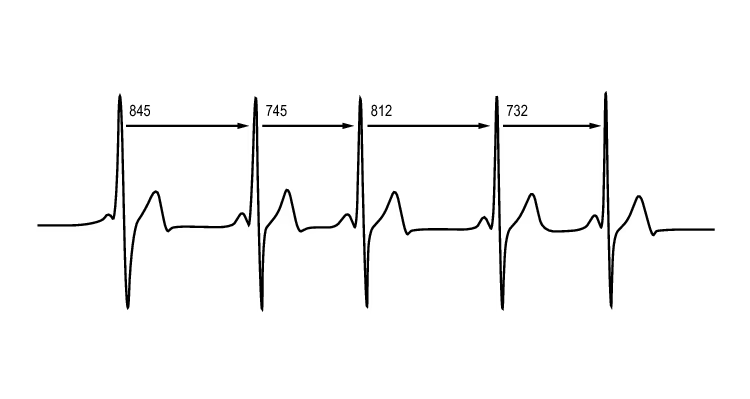
Heart rate variability is a measure of the variation in the time intervals between heartbeats (see image 1). For example, when you have a heart rate of 60 beats per minute, your heart does not necessarily beat every second. In a healthy heart, there might be 0.85 seconds between two beats one time, while another time it could be 1.15 seconds. Try it yourself: place a finger on your neck or wrist and feel the heartbeats. The longer intervals occur when you exhale, while the intervals are shorter when you inhale. When the intervals between two beats are almost constant, HRV is low; when there is more variation between these intervals, HRV is high. HRV is not always the same; when you are in a stressful situation, such as during training or while watching a horror movie, it will be lower than when you are, for example, meditating.
Image 1: time interval between heartbeats (www.support.polar.com)
HRV and stress
Various studies have shown that low HRV is an indicator of stress in the body. Low HRV is even an early indicator of depression, cognitive problems, and heart issues.2 Since stress is a major cause of various diseases, it is important to monitor this and find ways to reduce stress. We measure HRV before a training session with a heart rate monitor; the measured HRV provides us with information on how to approach the training. Because low HRV is an indicator of stress and indicates that the body has not recovered well, we organize the training differently than when someone has a high HRV. We advise against training at high intensity with low HRV, as this can also fatigue the neurological system significantly. Training endurance (the aerobic system) through compound exercises at low intensity is a better option. For example: if you can squat 100 kg once, now do 20-25 repetitions with 30 kg and take about 60 seconds of rest afterward.
Why is HRV variable?
The autonomic nervous system has two different branches, the parasympathetic part (rest & digest) and the sympathetic part (fight or flight). The parasympathetic nervous system influences the body in such a way that it is in a state of rest where the body can recover. The sympathetic nervous system, also known as 'fight or flight', puts the body in a state where it can perform work. The two systems continuously work together. The collaboration of the parasympathetic and sympathetic nervous systems affects HRV.3 When the parasympathetic part is more activated, this results in a high HRV; when the sympathetic system is more activated, this results in a low HRV.3 As the activity of the parasympathetic nervous system decreases with age, we see in practice that HRV is often lower in older adults.4,5
What do HRV scores mean?
We consider a good HRV score to be a score of 75 (+/- 10). A less favorable HRV score is a score below 50.
High (75 +/- 10):
better fitness level and endurance
better overall health
better coping with negative experiences
calm, positive emotions
younger age
better recovery
Low (<50):
lower fitness level and lower endurance
worse overall health
increased risk of cardiovascular diseases and inflammation
negative emotions
anxiety and depression
older age
not fully recovered
These scores of 75 and 50 are simply general guidelines; the HRV score is different for each individual, and age also influences this. The image below shows how the HRV score develops as you age. Therefore, it is important to measure your HRV score more often to find out what a good score is for you. This way, you can get to know the development of your own HRV and draw conclusions based on this.

Source: Whoop – average HRV score vs. age
How do I improve my HRV?
You can use HRV to measure stress, but you can also actively stimulate and train it to:
better cope with stress
recover faster after exertion
achieve better focus
be able to relax better
With exercises like meditation6, walking, or breathing exercises, you can increase your HRV. Block breathing is a good example of this. In this exercise, you inhale for 4 seconds, hold your breath for 4 seconds, and exhale for 4 seconds. Getting good sleep and eating nutritious food generally also leads to a better HRV score. If you know that you are not fit, it is also advisable to work on this through exercises as mentioned earlier.
Are you curious about how much stress your body is experiencing? Come by to have your HRV measured and gain insight into your health!
Sources
1. Thayer, J.F., Lane, R.D. (2007). The role of vagal function in the risk for cardiovascular disease and mortality. Biol. Psychol, 74, 224–242.
2. Castaldo, R., Melilla, P., Bracale, U., Caserta, M., Triassi, M., Pecchia, L. (2015). Acute mental stress assessment via short term HRV analysis in healthy adults: A systematic review with meta-analysis. Biomedical Signal Processing and Control, 18, 370-377.
3. Thayer, J.F., Åhs, F., Fredrikson, M., Sollers, J.J., Wager, T.D. (2012). A meta-analysis of heart rate variability and neuroimaging studies for heart rate variability as a marker of stress and health. Neuroscience and Biobehavioral Reviews, 36, 747-756.
4. Antelmi, I., de Paula, R.S., Shinzato, A.R., Peres, C.A., Mansur, A.J., Grupi, C.J. (2004). The American Journal of Cardiology, 93, 381-385.
5. Pfeffer, M.A., Weinberg, C.R., Cook, D. (1983). Differential changes of autonomic nervous system function with age in man. Am J Med, 75, 249–258.
6. Phongsuohap, S., Pongsupap, Y., Chandanamattha, P., Lursinsap, C. (2008). Changes in heart rate variability during concentration meditation. International journal of Cardiology, 130(3), 481-484.
Also read: Staying fit during menopause: 5 lifestyle tips · more articles on our blog · personal training at Daadkracht.