

In this article about circadian rhythm and shift work: Did you know that by establishing a consistent rhythm, you can lose fat more easily, build muscle mass, have more energy during the day, improve your sleep quality, and enhance overall long-term health? This rhythm is also known as the circadian rhythm. In this blog, we will tell you more about it!
Circadian rhythm and shift work explained
All your internal processes follow a certain rhythm: the circadian rhythm, which is a biological day-night rhythm lasting 24 hours, also known as the 'biological clock'. Many people are familiar with the example of the sleep-wake rhythm. But did you know that all major systems have a circadian rhythm? Examples include our body temperature, sleep, hormone secretion, metabolism, heart rate, and blood pressure.
This is all well thought out by your body, but if your personal schedule does not sync with it, due to irregular working hours, a large dose of stress, or social activities, this rhythm gets disrupted. The result: your body no longer functions optimally. This leads to a decreased metabolism, increased production of 'negative' hormones, poorer recovery after a workout, reduced sleep quality, and increased hunger, just to name a few examples. In the image below, you can see what the circadian rhythm roughly looks like. This depends on your chronotype and various lifestyle factors. See if you can relate to this.
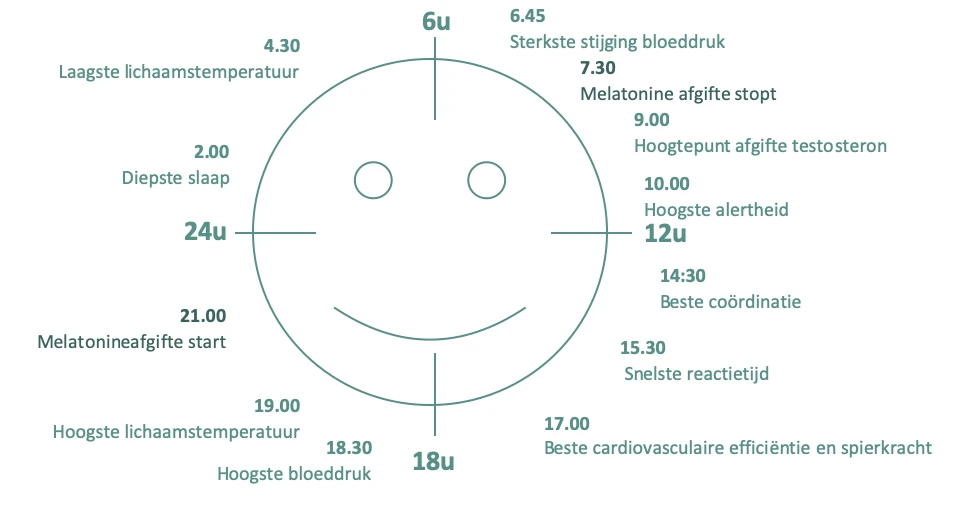
As seen in the image above, you wake up because the production of melatonin decreases. Melatonin is the hormone that largely controls your sleep-wake rhythm. Among other things, due to the release of testosterone, you are most alert around 10:00 AM. The end of the afternoon is the best time to perform physically because around 5:00 PM your strength and cardiovascular system are working optimally. When the sun sets, melatonin makes you feel sleepy. So, you can see that there are peaks and troughs throughout the day regarding hormones, blood pressure, and body temperature. There are moments when you can sleep best (during the night) and moments when your body is more alert, allowing you to be more active again. By optimally utilizing these moments, your body functions best, and you live more vigorously.
It is striking that in depressed individuals, these peaks and troughs are much less pronounced. The release of certain hormones and also, for example, body temperature shows less significant fluctuations over a 24-hour cycle. In these individuals, the circadian rhythm does not function optimally anymore.
But how do you ensure that the circadian rhythm is not disrupted? Make sure you are not exposed to much light in the evening, and do so in the morning instead. Move during the day; in the evening, you want to rest. Resting in the evening helps you become sleepy. Temperature also affects our circadian rhythm. Increasing your body temperature in the morning and decreasing it in the evening positively influences your circadian rhythm.
As mentioned earlier, your rhythm is determined by your own chronotype, which dictates what your circadian rhythm looks like. For example, if you are a night owl, you will become sleepy less quickly and have more trouble getting out of bed in the morning. This is the opposite for a morning person, which largely has to do with the timing of hormone release. This chronotype varies by life stage but remains almost the same as an adult. Unfortunately, it is not always possible, but try to adjust your work schedule to your circadian rhythm; this will make you significantly more productive and help you sleep better.
To optimize your circadian rhythm, it is important to establish a routine. There is a 'best time' for every activity. Below is a list of actions you can take.
Wake up at fixed times (even on weekends)
Have breakfast at a fixed time
Around 10 AM, you are most alert, a good time to work!
Have lunch at a fixed time
Take a short walk outside; exposure to daylight delays sleepiness
Work
The afternoon is the best time to exercise
Have dinner at a fixed time
Relax
Dim the lights, ensure warm lighting, and lower the room temperature
Establish an evening ritual, such as taking a warm shower, which lowers body temperature
Go to bed at a fixed time in a dark room
Establishing a rhythm like the one above is quite manageable for most people with a daytime job. However, when you work shifts, this becomes much more challenging, and it is harder to align your lifestyle with your circadian rhythm, leading to disruptions. Working shifts is often associated with various health issues, such as sleep disturbances, gastrointestinal problems, and cardiovascular health. Managing light, nutrition, movement, and temperature becomes even more important.
Establish fixed habits per shift. For example, if you work one week from 6:00 AM to 2:00 PM and the next week from 4:00 PM to 12:00 AM? Maintain the same rhythm but shift it by 3 hours when you have a later shift. For example, waking up at 5:00 AM vs. 9:00 AM.
Do you have a night shift? Then it gets a bit trickier. Make sure that after you wake up in the afternoon, you get enough daylight, and exercise before you go to work. In the middle of the night, have your last meal and go to bed around 8:00-9:00 AM.
Also read: Stay fit during menopause: 5 lifestyle tips · more articles on our blog · personal training at Daadkracht.