
Pull ups: everything you need to know
In this article about pull-ups: Perhaps you once pulled yourself up on a climbing frame in the playground or see your children doing it with ease now. But even as an adult, it is a challenging exercise to train your upper body. In this blog, you will discover everything about this strength exercise.
What are pull ups?
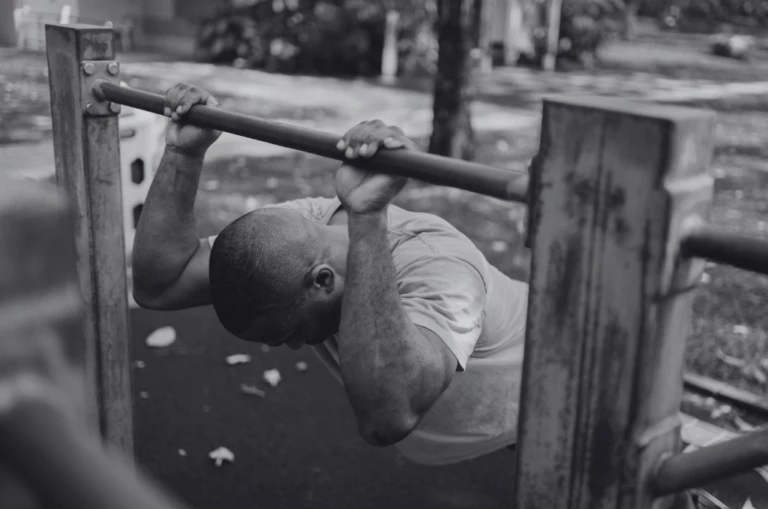
The pull-up is an exercise where you pull yourself up on a bar with an overhand grip (palms facing away from you). It is one of the most effective exercises to train the back muscles, shoulders, and biceps. Pull-ups are often confused with chin-ups, but the difference is that chin-ups use an underhand grip (palms facing you), which places more emphasis on the biceps.
What are the benefits of pull ups?
Pull-ups have many benefits, especially if you want to build a strong upper body. Here are the main benefits:
Muscle building and strength
With pull-ups, you train a large part of your upper body, namely the back muscles (latissimus dorsi), biceps, shoulders, and forearms. Additionally, you also strengthen the core (abdominal muscles and lower back) because your body needs to stabilize itself.
Efficient compound exercise
By doing pull-ups, you train multiple muscle groups at once (also known as a compound exercise), allowing you to see results from your training faster.
Improved grip strength
You strengthen your hands, wrists, and forearms, which also helps in other sports such as climbing or weightlifting.
Improved posture and mobility
With the pull-up, you strengthen the back muscles, which helps you sit with a good straight back. Additionally, you also improve shoulder mobility, which is beneficial for other strength exercises such as bench pressing and deadlifts and helps prevent injuries.
Can be done anywhere
To do pull-ups, you don't need expensive equipment. Just a bar to hang from is sufficient, making it easy to add this exercise to your home workouts or outdoor training.
What variations of the pull-up are there?
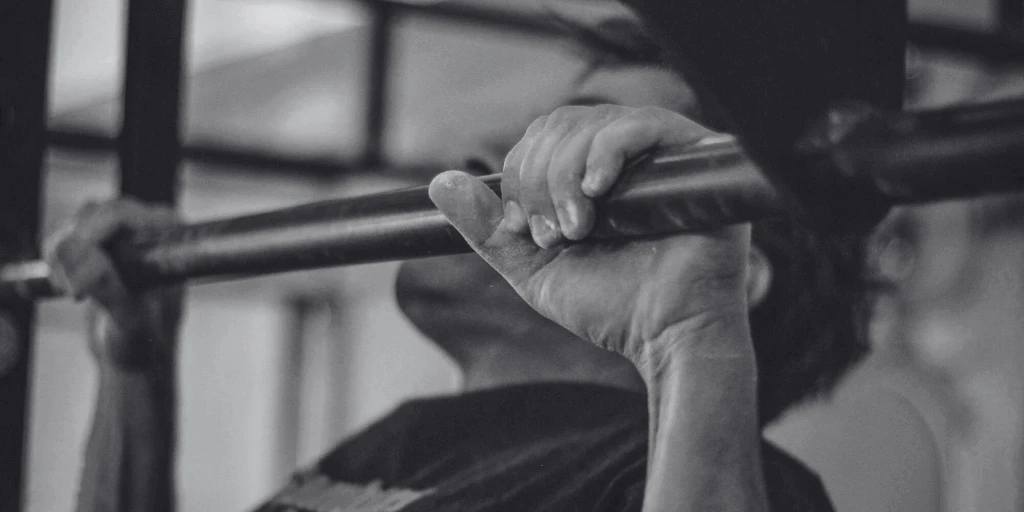
There are many different variations of the pull-up. This is a good thing, as it is likely difficult to perform a strict pull-up without experience. This is a pull-up where you pull yourself up in one go and lower yourself back down in a controlled manner. If you are just starting with pull-ups, that might be too heavy. By building up the variations, you can gradually work towards a strict pull-up. Here are the variations from beginner to advanced:
Beginner (For strength building and technique)
Negative pull-ups
Jump up so you start in the top position of a pull-up.
Lower yourself slowly and in a controlled manner until your arms are straight.
This helps build strength if you cannot yet do a full pull-up.
Assisted pull-ups
Use a resistance band or a pull-up machine for support.
The band helps you up by carrying part of your weight.
Ideal for learning the technique and building strength.
Australian pull-ups (inverted rows)
Lie under a low bar and pull yourself up at an angle.
Keep your body straight and engage your core.
This exercise trains the same muscles as a pull-up, but with less load.
Intermediate (For muscle growth and variation)
Chin-up
Use an underhand grip (palms facing you).
More emphasis on the biceps and less on the back.
Easier than a regular pull-up due to extra bicep activation.
Standard pull-up
Use an overhand grip (palms facing away) at shoulder width.
Pull yourself up until your chin is above the bar.
Lower yourself down in a controlled manner and repeat.
Wide-grip pull-up
Place your hands wider than shoulder width.
This variation places more emphasis on the upper back muscles (lats).
Harder than the standard pull-up due to the wider grip.
Advanced (For extreme strength and control)
Archer pull-ups
Pull yourself up to one side while keeping the other arm almost straight.
This helps with the transition to a one-arm pull-up.
Builds strength in one arm at a time.
One-arm pull-up
The ultimate test of pure strength!
Pull yourself up with just one arm (the other arm can be used for support on the wrist).
Requires a very strong back, arms, and grip strength.
Weighted pull-ups
Perform pull-ups with extra weight (for example, a belt with plates or a dumbbell between your legs).
Builds extreme strength and muscle mass.
So plenty of variations to get stronger at doing pull-ups!
Pull-ups: common mistakes and how to avoid them
Although pull-ups are an effective exercise, many people make mistakes when performing the pull-up, making them less effective or even causing injuries. Here are the most common mistakes with pull-ups and how to avoid them.
1. Half repetitions (not fully extending or pulling up)
Mistake: Only pulling up a little bit and not fully lowering.
Solution: Make sure to pull yourself all the way up (chin above the bar) and fully extend when lowering.
2. Swinging or kipping (kipping pull-ups without control)
Mistake: Using too much momentum (causing you to lose muscle tension) and swinging your body.
Solution: Pull yourself up in a controlled manner and lower yourself slowly. Engage your core to prevent swinging.
3. Incorrect grip width
Mistake: Holding too wide or too narrow, which increases the strain on the shoulders or wrists.
Solution: Maintain a grip slightly wider than shoulder width for optimal back activation.
4. Too much arms and not enough back
Mistake: Only using the biceps instead of the back muscles.
Solution: Think about pulling your elbows down instead of pulling yourself up with your arms. This activates the back better.
5. Lowering too quickly (no eccentric control)
Mistake: Falling down all at once without control.
Solution: Lower yourself slowly and in a controlled manner to maximize muscle growth and strength development.
6. Not Building Progress
Error: Trying to do strict pull-ups too quickly without building strength.
Solution: Start with negative pull-ups or use a resistance band first to get stronger. This way, you can gradually work towards a strict pull-up.
Doing Pull-ups at Daadkracht
Regularly doing pull-ups helps you build strength in your upper body and is a fun and challenging exercise that you can improve on with various modifications. Need help? Book a free trial lesson at our studio in Overveen or Heemstede and work towards your fitness goals under the professional guidance of a personal trainer.