

In this article about injury management, how do you do that: Everyone has had an injury at some point. An overloaded knee, shoulder, or lower back are common occurrences. But how do you deal with such complaints? Rest, seek treatment, continue training? Logical questions, yet there is still much uncertainty about them. The doctor's advice is usually to rest, ice, and take anti-inflammatories while a physiotherapist will treat the complaint and provide you with exercises. We dove into the literature and give you our perspective on injury management.
Injury management how do you do that explained
Diagnosis
Let’s be clear that personal trainers are not doctors or physiotherapists. We have a lot of knowledge about the human body and can recognize relatively 'simple' injuries and adjust training accordingly. However, for certain symptoms, it is advisable to seek medical help, such as total loss of Range-Of-Motion, internal damage to a muscle or joint, or when you experience increasing pain over 72 hours. Additionally, it may be necessary to visit a physiotherapist to have the complaint treated and receive appropriate advice.
Active recovery
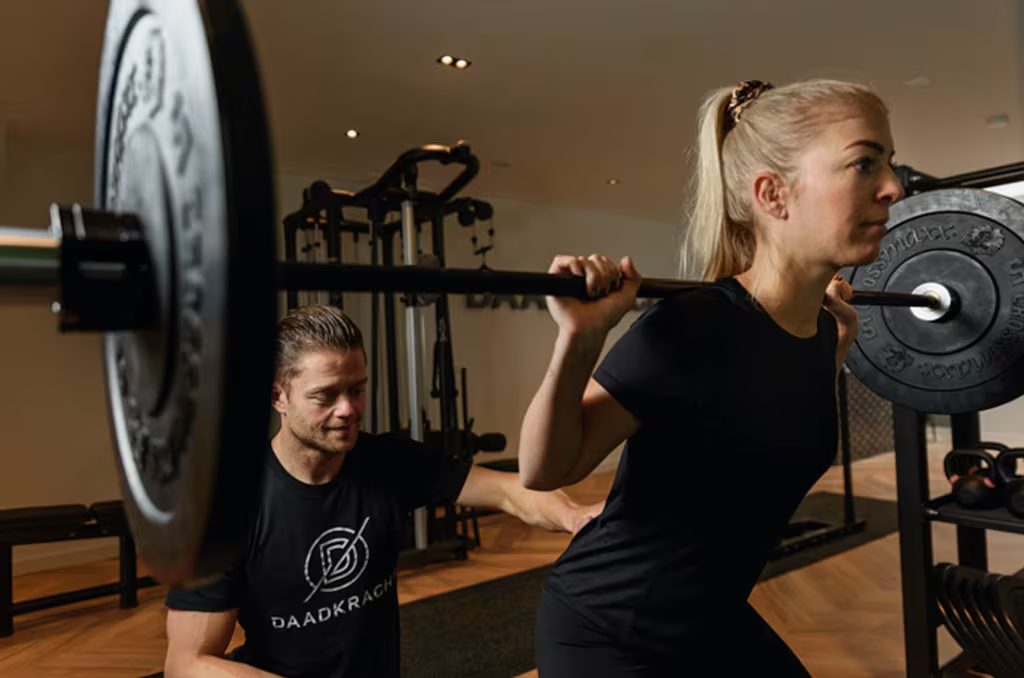
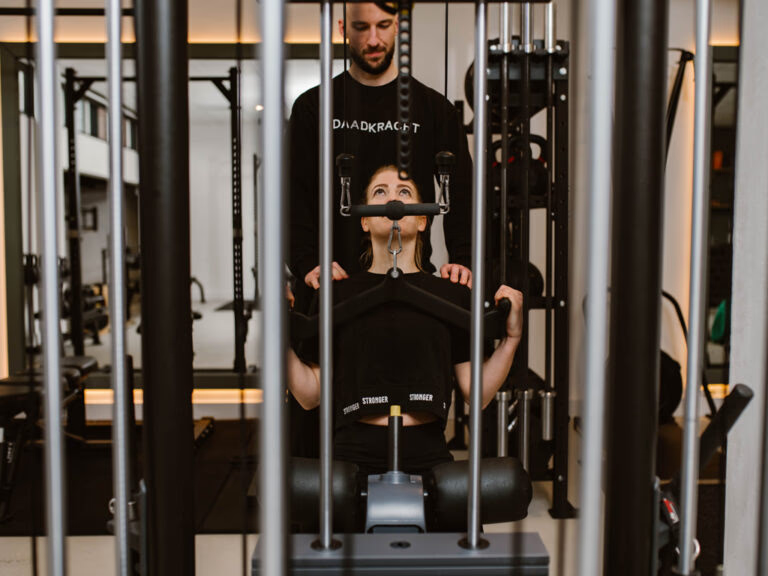
Many people see injuries as an excuse to stop training. A doctor often advises to rest as well. However, this causes your body to become stiff and does not address the root cause of the complaint. Active recovery accelerates the healing process. Exercise increases growth hormones, activates the immune system, and significantly increases blood flow to your connective tissue during training. These factors support the recovery process, and we definitely recommend continuing to train even if you are injured. Be creative; if you have issues with your lower body, you can still train your upper body and vice versa. We can certainly help you with this.
We also assist our athletes with movement when they have an injury. For this, we have developed a special program. Want to know more? Check out our rehabilitation Haarlem page.
Pain

Training is definitely recommended even if you have an injury. The key factor here is the level of pain you experience. Pain is a mechanism and can be seen as a way your body communicates. When you experience pain, it actually sends a signal that your body is under too much strain. As you become accustomed to training, you learn to distinguish between 'good' pain and 'bad' pain. For example, mild muscle soreness can be painful but is a 'positive' result of training. Joint pain or pain that feels like an electric shock (neurological) are important to recognize and should not be ignored. In general, but especially when training guided by pain while already injured, it is important to listen closely to your body.
Sustainable training program
When you experience a different type of pain than mild muscle soreness, it is advisable to adjust your training program. This way, you ensure that the pain does not lead to an injury or allow an existing injury the space to actively recover. There are several options for creating a sustainable training program:
Exercise Selection: the best way to create a sustainable program is by adjusting your exercise selection. Most injuries are very specific, and to prevent a minor ache or nagging pain from turning into an injury, it can help to swap the aggravating exercise for another.
Training Intensity: another way is to adjust your average training intensity. Intensity has a direct and exponential effect on the stress on the body and your muscles. Unless you are injured to the extent that you cannot move a body part at all, there is always an intensity that you can tolerate. You can lower the training intensity by, for example, reducing the weight and increasing the number of repetitions.
Training to Muscle Failure: aside from your exercise selection and training intensity, it is best not to seek muscle failure when in pain. Training to failure inherently means a loss of good technique. The worse your technique, the worse the tissue stress distribution. Using short rest intervals will increase the proximity to failure and make it harder to maintain perfect technique. If you experience pain in your body or are injured, we strongly advise against training to muscle failure. Take sufficient rest between your sets and do not push your limits too much.
Repetition Tempo: the last option is to adjust your training schedule. By training at a slower repetition tempo with lower training weights, your joints are spared while still achieving a high level of muscle activation. In our article Time Under Tension, we explain how to do this best.
Do you want guidance in exercising with injuries?
In our studio, we guide people in achieving their physical goals and adopting a healthy lifestyle. This is not only focused on losing weight or getting stronger. We primarily focus on living healthier and aging well. You will notice that your knees are not as flexible in your forties as they were in your twenties. This is one of the topics that falls under injury management and is addressed by us. Would you like to try personal training in Haarlem? Feel free to contact us.
We hope to provide more insight into how to deal with injuries. Do you have questions or need advice? We are happy to help!